Dallas Warehouse Costs: The 2026 Throughput Math
Rent is not what a Dallas warehouse really costs you. Model occupancy, dock capacity, and the 3PL crossover before you sign anything.
Most operators searching for Dallas warehouse space are comparing the wrong number. They collect quotes — $8.25 here, $9.10 there — normalize them by square foot, and pick the middle. Then the facility opens, the first peak season arrives, and the building that looked cheapest turns out to be the most expensive asset on the balance sheet.
The reason is structural. Rent is a rate. What you actually pay is a cost per unit that leaves the dock, and that number is governed by how fast the building can move freight, not how much floor it has.
Three costs hide behind the quoted rate
Every Dallas warehouse proposal carries a rate that excludes most of what you will spend.
- Net rent plus NNN. Base rent is the headline; the triple-net load (taxes, insurance, maintenance) is the reality. In DFW the NNN component has been the volatile half, and it resets on the tax appraisal cycle rather than on your lease anniversary.
- Fit-out and racking. A building delivered as shell needs racking, sprinkler modification, dock equipment, and material handling before a single pallet moves. This is capital, and it is rarely in the comparison spreadsheet.
- Throughput loss. The invisible cost. If the dock configuration cannot absorb your peak inbound, you do not save money — you rent overflow trailers at spot rates and pay overtime to clear the floor.
Only the first line appears in the broker's email. The other two decide whether the deal works.
Dock doors are the real constraint
Square footage is the number everyone negotiates and the number that matters least. Throughput capacity is a function of doors, turns, and pallets per turn.
The working model:
Doors × turns per day × pallets per turn = daily dock capacity
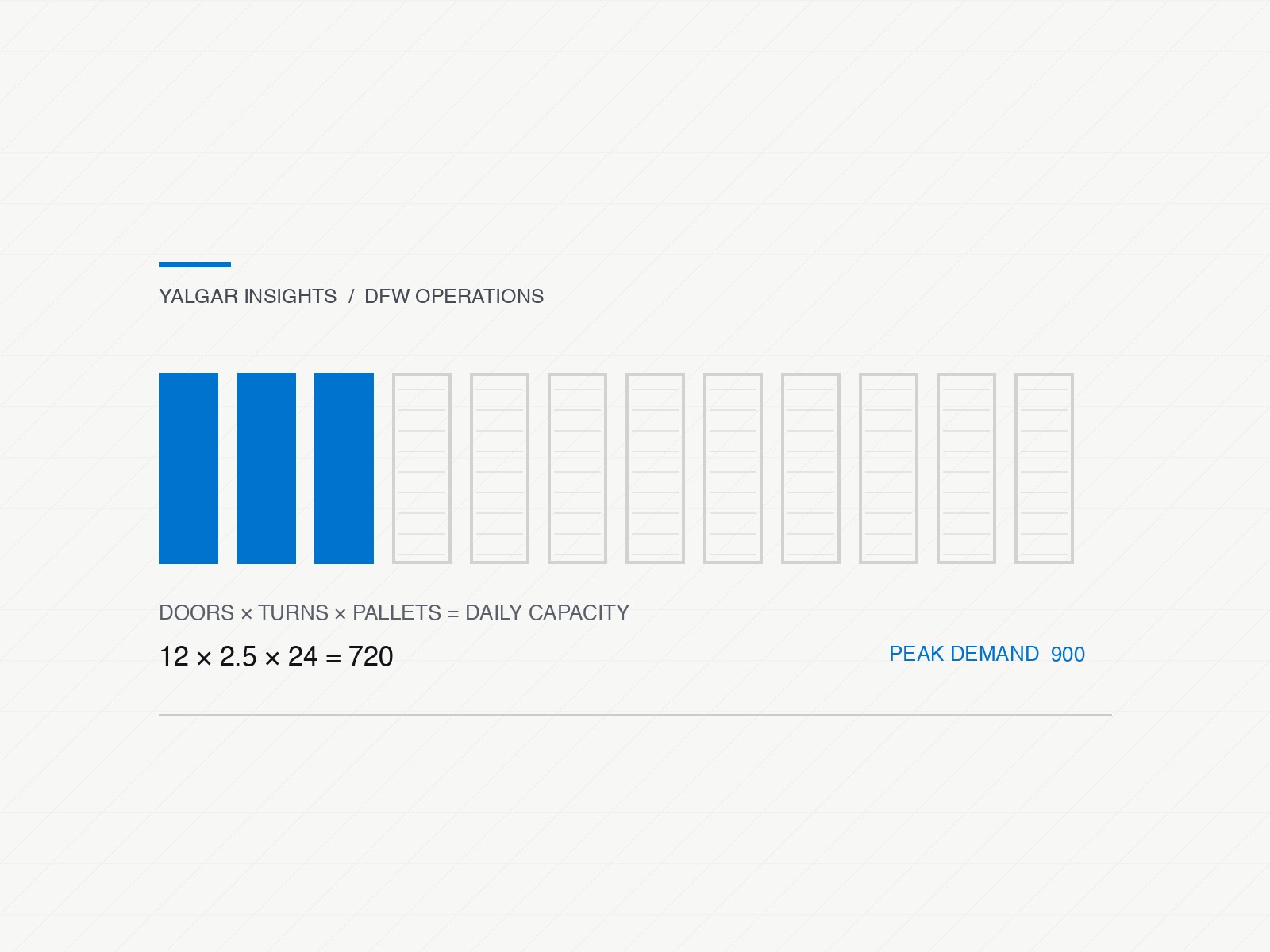
An illustrative mid-size DFW facility: 12 doors, a realistic 2.5 turns per shift, 24 pallets per turn on a 53-foot trailer.
12 × 2.5 × 24 = 720 pallets per day of theoretical inbound capacity.
Now compare that to the peak, not the average. A distributor taking 900 pallets on its heaviest day is short roughly 180 pallets of capacity — and no amount of additional racking fixes a door shortage. Trailer dwell, yard congestion, and detention fees are the symptoms. The disease is the building's geometry.
This is where operators most often mistake a real estate decision for an operations decision. The question is not "how much space can I lease" but "how many doors, in what configuration, at what dwell time."
The lease-versus-3PL crossover
The second decision is whether to take the space at all. A lease converts a variable cost into a fixed one, which is correct when volume is stable and predictable, and dangerous when it is not.
The crossover is arithmetic:
- A lease has a fixed annual burden: rent, NNN, amortized fit-out, minimum staffing.
- A 3PL has a variable unit rate that scales with volume, carries a margin, and prices in its own risk.
Plot total cost against monthly pallet volume. The lease line is flat then rises in steps as you add shifts; the 3PL line rises steadily. The crossover — the volume at which owned space becomes cheaper — typically sits where your fixed burden divided by the 3PL's per-pallet margin equals the volume you can reliably sustain.
Two conditions decide it: volume stability and the value of control. If your volume swings below the crossover for several months a year, the lease is a bet that you can fill the building, and you will pay that bet in overhead rather than in unit cost.
A worked example, kept honest
Numbers below are illustrative — the structure matters more than the inputs, and any real model should be built from your own quotes and your own pallet history.
Take a 200,000 square foot DFW building at $8.75 per square foot NNN, with the tenant responsible for racking and dock equipment. Annual base rent is $1,750,000. Add NNN and the fixed burden rises several hundred thousand more. Add amortized fit-out across the term.
Now divide by realistic annual outbound pallets — not the theoretical maximum, but what the dock can actually clear at peak. If the building supports 720 pallets a day at peak and you operate 250 days, the ceiling is 180,000 pallets a year. At 70% utilization that is 126,000 pallets.
The intuition most operators carry — "cheaper rent means cheaper operations" — only holds if both buildings have the same dock capacity. They almost never do. A building at $8.25 with four fewer doors can cost more per pallet than the $9.10 building next door.
The three lines worth negotiating
Once the model is built, negotiation narrows to three items that actually move the number:
- Dock allocation and exclusivity. Doors, trailer parking, and yard positions. Cheap to concede on paper, expensive to expand later.
- Expansion rights. A right of first offer on adjacent space protects you from a second move when volume grows — and it costs the landlord nothing today.
- Capital pass-throughs. Who pays for sprinkler upgrades, dock levelers, and power drops. These are the items that turn a signed deal into an overrun.
Rent negotiation gets the attention; these three decide whether the facility still works in year three.
Before you sign
Dallas warehouse space is not scarce. Warehouse configurations that can absorb a peak are. The operators who get this right model door capacity and the 3PL crossover before they tour a single building — and they walk away from the cheap building with the wrong geometry.
If you are evaluating DFW space this quarter, we build the throughput model first and price the lease against it. That is the difference between renting a building and buying capacity.
Request an executive briefing to walk through the model against your own volume, or read how we approach supply chain throughput and hostile procurement when the lease is already signed and the terms turn out to be worse than the headline rate.